What’s Your Perspective?

What’s your perspective? Is it right for what you need to achieve?

It is so important to keep it well rounded, balanced and in the creative zone.

Sometimes, though, we feel like we exhaust ours. So what can we do to keep it right?

A great tip is to put on someone else’s. For example, how would Walt Disney think or see the problem? Or, how would a child see or solve the problem?

Here are three helpful steps to help build a new perspective:

  1. Identify the problem – be specific!
  2. Assemble an eclectic group of minds and for 20 mins let ideas flow. Be sure to embrace a ‘no filters’ policy for this part… just let creativity flow.
  3. Review, reflect, be inspired and decisive and then take on your new actions.

Having the right perspective makes a big difference in how we respond internally to situations and how we communicate with those important people around us.

Having the right perspective is a choice! You have to make it!


It’s very invigorating getting your perspective right again. It’s like getting your groove back!

Wellbeing & Resilience

Over the past few months, I have been thinking a lot about wellbeing and resilience. Both of these terms come up a lot when talking with parents, leaders and colleagues as we explore the ideas of growing and change.

As such the question buzzing around in my mind is: to create or strengthen a family unit or to develop a brilliant work culture where do I focus my thinking and actions?

I started exploring this quest by clarifying the two terms.

Well-being relates to our sense of agency around our health, happiness, social and emotional connectedness and our mental and spiritual wellness.

Resilience is our ability to bounce back from a problem or a challenge which we might face.

This got me thinking… if I focused my attention on developing wellbeing then resilience should be directly impacted as a result.

As I think about my experience as part of a family, as a therapist, an educator and a leader, the greatest resource for purposeful change or growth was when wellbeing was in focus. As wellbeing was built and strengthened it seemed so was the capacity to handle both the good and the bad.

With this in mind, developing wellbeing is critical to personal, family and organisational growth.

How do we do this? These are just a few tips from my reading and experience, which really helped my family and the organisations I lead to know their worth and build their wellbeing:

  • Make time to get to know the people’s thinking and perspectives
  • Look for every and any opportunity to build upon and work with existing capacity and strengths
  • Use specific encouragement to build a sense of value and place
  • Collaboratively set goals or activities which both stretch and draw on capacity and strengths
  • Get talking about how goals are achieved
  • Spend time reflecting on how many obstacles were overcome
  • Applaud every aspect of initiative and purposeful action which highlights strengths and capacity
  • Look for opportunities to share wins and successes with others
  • Acknowledge growth and be curious as to how it came about
  • Be explicit when you find ways where family or team members need and utilize one another and their strengths or capacities

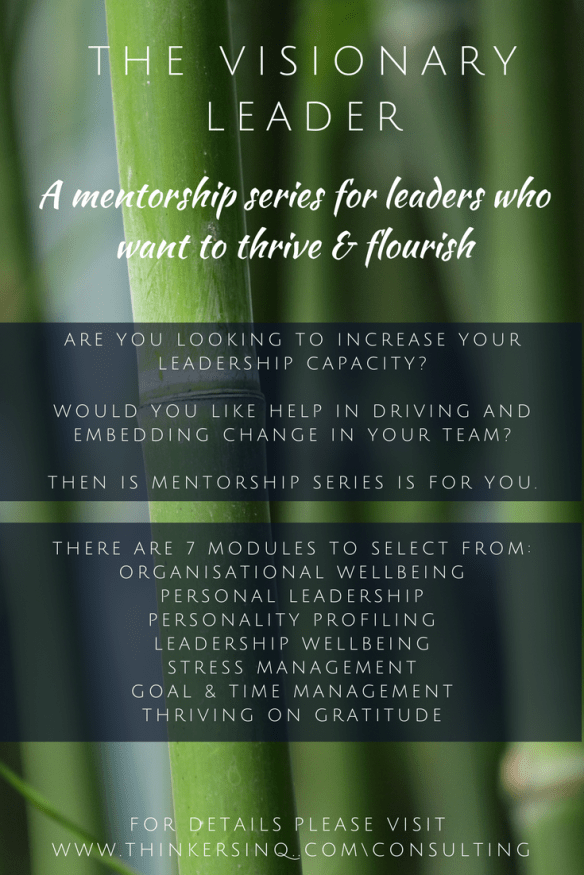
A Visionary Leader ~ A Mentorship Series

The Visionary Leader – Mentorship series is a 7 module program for leaders who want to increase their leadership capacity or would like help driving and embedding change in their team.

Presenter: Rod Soper. He is the co-founder of Thinkers.inq, a cutting edge and thriving learning community and the lead consultant of Thinkers.inq Consulting. With 15 years of leadership experience, Rod will inspire, guide and influence how you lead yourself, your organisation and your teams in order to become the leader you have always wanted to be.

extraordinary leadership-2


The Visionary Leader – Mentorship Goals

Leaders will:

  • Be able to articulate their purpose
  • Have a personal and professional leadership vision
  • Have a bespoke leadership map for delivering change
  • Be able to deliver tools which will empower their leadership enabling teams to flourish
  • Celebrate as change is successfully embedded through an Action Research Project

The modules leaders can select from are:

ORGANISATIONAL WELLBEING

  • Well-being verses resilience – which to spend time one for maximum organisational impact
  • Understanding the key elements of inspiration to help team members change
  • Leading change – understanding communication and processes to embed change

PERSONAL LEADERSHIP

  • Development of personal and professional leadership vision.
  • Identification of personal and professional purpose.
  • Understanding agency as a tool for personal thought leadership and team leadership
  • How to develop your personal brand within an organisation
  • Creating a play history in order to engage innovation

PERSONALITY PROFILING

  • Hogan assessment – These assessments include a variety of scales that create profiles to reveal competencies, derailers, values, reasoning skills and leadership characteristics.

LEADERSHIP WELLBEING

  • Understanding the importance of mindfulness as a transformational leader
  • Developing well-being and vitality in the workplace
  • How to make the right connections to maintain a strong sense of self in the workplace.

STRESS MANAGEMENT

  • How to build a strong sense of self to enable a calm response in the face of stress
  • Strength spotting assessment to work with team capacity
  • Developing a team of problem solvers
  • Managing culture fatigue for leaders

GOAL & TIME MANAGEMENT

  • What is the true purpose of goal setting: helping to achieve change within the organisation’s vision
  • Setting goals to get the right people in the right seats in your team
  • Stakeholder analysis: managing your goals and team goals
  • Time Management: reaching your goals

THRIVING ON GRATITUDE

  • Understand and experience the breadth and depth of a leaderful life steeped in gratitude
  • Learn how to use the influence of gratitude in leadership and decision making
  • Implement 101 ways of being grateful for the workplace

COST:

Each module runs for a period of 6 months and multiple modules can be completed, similtaneouly.

For one module: $1000

two -five modules: $750 per module

All seven: $500 per module


Designing Your Thinking

Have you ever been in a situation where you felt ‘stuck’… an argument, a toxic relationship, a seemingly incurable dilemma? The result leaving us to regularly ruminate about the interaction/s. What do we do to break this thought cycle? How we do it is so important to our wellbeing and growing our capacity.

These opportunities however can be super powerful in guiding us to make some serious life changing decisions. Decisions that matter. Decisions which shift us up a gear, steering us onto the ‘open road of free thinking’.

Firstly, clear and evidence-based thinking is the tool we want use to get us thinking in the right way. But how do we get that clarity? Some suggest a run or a workout to clear the mind. While others suggest a good shop or taking a moment to visit a favourite location to bring a clearer perspective. These are some good suggestions but they can only bring us part way to solving this kind of personal challenge.

The second step, and the more complex one, is what we decide to focus on when we are critically thinking. One thing we know for sure is that complex thinking is rarely resolvable in an instant. We must strive, i.e. consistently work hard to make choices which visibly change our pathway. By this I mean our behaviour must change to match our change in thinking. For example, saying I’ll stop eating chocolate and then having some a few hours later isn’t matching thinking and behaviour. Saying you will not eat chocolate every day and then eating small portions only on the weekend does match behaviour with thinking.

One sure-fire tool to break the ‘stuck thinking’ cycle we firstly need to stop complaining about the situation. Complaining to ourselves and others is not good for our wellbeing. We also need to stop taking offense. This offense is the birthplace of resentment and there is simply no goodness in resentment. None whatsoever.

Thirdly we need to look for new thinking opportunities. To do this, some people I know write their thinking down, while others share ideas with a mentor to unpack the complexities of thought. I personally find a combination is perfect for me. The conversation with a mentor cuts the complaining out and sets the new thinking on the right track. The writing helps to form an accountability for the new thinking opportunities. Together these two create and support a world of change for me. As a result I can now begin spending my time thinking about what’s to come rather than what caught me up.

As a leader I know the importance of these deliberate actions. Leaders know that these steps provide the power and the purpose to embark on the next step in ones journey. They know it gets them to the ‘open road’ and sets them on a new course of thinking and possibility.

There maybe some other strategies which work for you… I’d love to hear about your tools to successfully unstick your thinking habits.